
Allendale County Unclaimed Property Records
Allendale County is one of South Carolina's smaller counties, but residents still have unclaimed money held by the state waiting to be returned. The South Carolina State Treasurer's Office maintains a free public database of unclaimed funds from banks, insurance companies, employers, utilities, and other holders. Anyone who has lived or worked in Allendale County — or whose relatives did — should take a few minutes to search the official database. Claiming what is yours is free and the funds are held without any deadline.
Allendale County Quick Facts
Allendale County and Unclaimed Money Basics
Allendale County, with the town of Allendale as its county seat, is located in the southern part of South Carolina. Despite its smaller population, county residents can have unclaimed accounts in the state database from years or even decades ago. Financial institutions, utility companies, employers, and other businesses that operated in Allendale County are required by state law to report dormant accounts to the South Carolina State Treasurer after a set period of inactivity.
The Allendale County government website provides contact information for local offices including the Treasurer and Auditor. County Treasurer Valaree Smith oversees county financial accounts, while County Auditor Crystal Isham handles property assessment matters. The Clerk of Court, Elaine Sabb, manages court records and court-held funds. These local officials interact with the state system when county-level accounts go dormant and must be reported.
The county government website is the starting point for residents who need to contact local financial offices or find supporting documentation for a claim.
The South Carolina State Treasurer holds more than $1 billion in total unclaimed property statewide on behalf of residents in all 46 counties. Treasurer Curtis Loftis has returned more than $420 million to rightful owners since 2011. Last year alone, the program returned $36.7 million. These numbers reflect how common it is for funds to go unclaimed and how much money is waiting to be recovered by diligent searchers.
Note: Even if your name does not appear in the database today, it is worth searching again after each November 1 reporting deadline, when new records are added from the prior year's reports.
How to Find Unclaimed Funds from Allendale
Start your search at the South Carolina official unclaimed property search portal. The site is updated daily. Enter a first and last name and, if you like, add a city such as Allendale or Fairfax to narrow your results. The system will return a list of matching records showing the property type, value range, and the name of the business that reported the funds.
Once you find a match, start the claim process directly through the website. You will be asked to confirm your identity by submitting documentation. For most claims, a valid photo ID and proof of your former address — such as an old utility bill or bank statement — will be enough. The website provides a checklist of acceptable documents based on your claim type. After submission, you receive a Claim ID to track your status online.
Searching under multiple names is important. Check your current name, any former surnames, and the names of deceased parents or other relatives who may have had an address in Allendale County. Estate administrators can file claims on behalf of a deceased owner by submitting estate documentation along with the claim form.
SC Association of Counties and Allendale Unclaimed Property
The SC Association of Counties resource page for Allendale County provides information on county government structure and services. Understanding how local government is organized can help residents know which office to contact when researching unclaimed funds or gathering documentation for a claim.
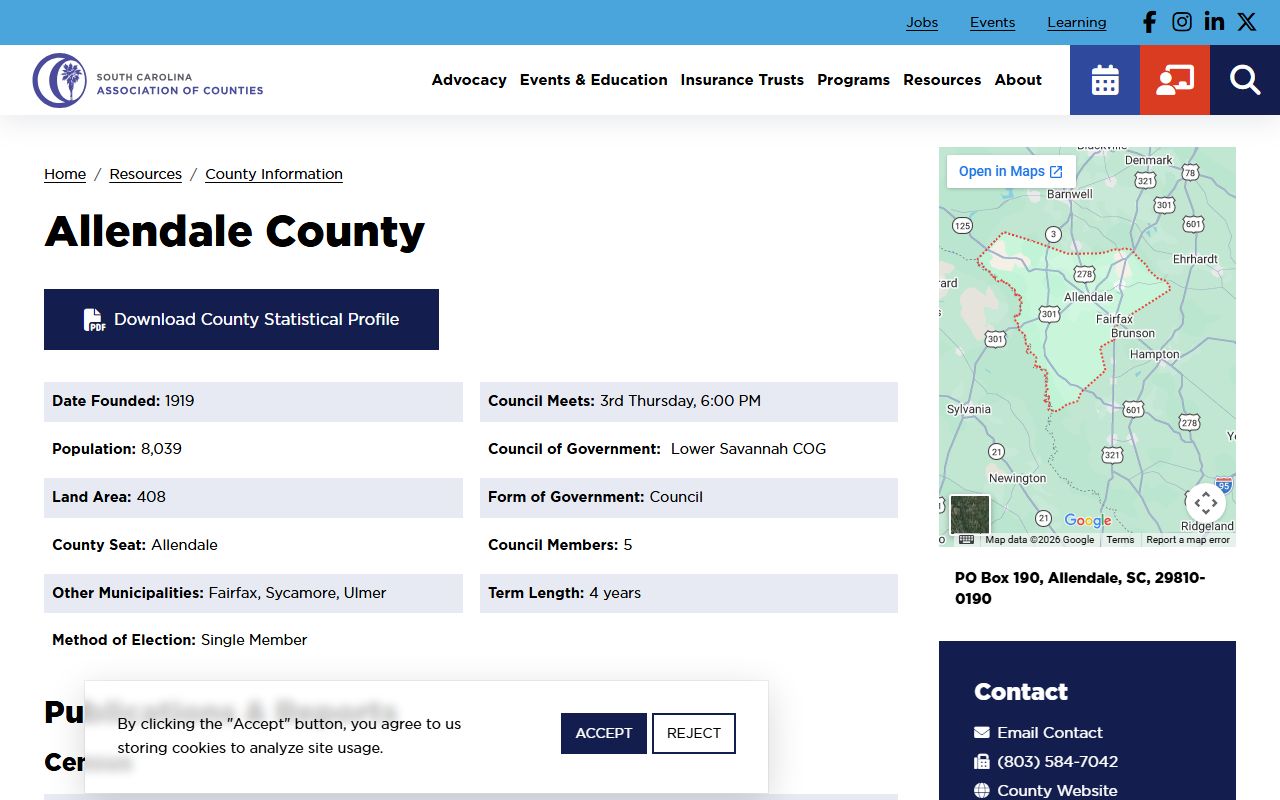
The SC Association of Counties also provides guidance to county governments on compliance with state financial laws, including their obligations to identify and report dormant accounts.
The SC Association of Counties works with all 46 counties to support good financial governance. Part of that work involves helping county offices understand their responsibilities under the Uniform Unclaimed Property Act. When county-held funds such as tax overpayments, court deposits, or other balances go unclaimed, county officers must follow the same reporting rules as private holders. This ensures that Allendale County residents who are owed money by the county can recover it through the state system.
County officers in Allendale are also required by SC Code Title 4, Chapter 11 to keep accounts open to public inspection. This means residents can request to review county financial records that may document unclaimed balances owed to them.
Note: To inspect county financial records in Allendale, contact the county administrator's office to understand the formal request process.
South Carolina Law Governing Unclaimed Property
The legal foundation for South Carolina's unclaimed money program is the Uniform Unclaimed Property Act, codified at Title 27, Chapter 18 of the SC Code of Laws. This law defines which types of property become reportable, when they must be reported, and what the state must do to notify owners and accept claims.
The general dormancy period under Section 27-18-30 is five years. Most bank accounts, brokerage accounts, and similar financial instruments follow this timeline. Wages and payroll checks are treated differently — they become reportable after just one year of inactivity under Section 27-18-160. Utility deposits also become unclaimed after one year under Section 27-18-90. Money orders carry a seven-year dormancy period, and travelers checks must be held for fifteen years before they can be reported.
Once a holder reports property to the state, they must also have completed the due diligence required by Section 27-18-180. This includes making a good-faith attempt to contact the owner during a 120-day window before the November 1 reporting deadline. The goal is to reunite property with its owner before it ever reaches the state database.
Common Types of Abandoned Property in Allendale County
Residents of Allendale County can have unclaimed property from many different sources. Old bank accounts are the most common, especially accounts opened at institutions that have since merged or closed their local branches. Savings accounts, checking accounts, and certificates of deposit that were opened years ago and then forgotten are regularly transferred to the state.
Insurance-related property is another frequent source. Life insurance policy benefits, premium refunds, and annuity payments that go uncollected eventually make their way into the state database. If a relative passed away and you are unsure whether all insurance proceeds were collected, a name search in the state database may surface unclaimed benefits.
Employer-issued checks represent a third major category. Payroll checks, expense reimbursements, and final settlement payments that were mailed to an old address and never cashed show up as unclaimed property after one year. Anyone who has changed jobs or moved away from Allendale County should check for uncashed employer payments in the database.
The South Carolina dormancy table lists the holding period for every category of property, from standard bank accounts to court deposits and government-issued checks. Reviewing this table helps set expectations for when a specific type of account would appear in the database.
Federal Court Unclaimed Funds for Allendale Residents
Some unclaimed money tied to Allendale County residents may be held outside the state system. The US District Court for South Carolina maintains its own list of unclaimed bankruptcy funds. These are distributions from bankruptcy cases where the creditor or claimant never cashed their check. The court can be contacted at 803-765-5436. Residents who were involved in a federal bankruptcy case — as a creditor, employee, or other party — should check this resource separately from the state database.
The Municipal Association of South Carolina also provides guidance to municipalities like the Town of Allendale and the Town of Fairfax on how to properly report unclaimed property held at the local level. This ensures that even small municipal refunds and deposits eventually reach the state database where owners can find them.
Cities in Allendale County
Allendale County includes the Town of Allendale and the Town of Fairfax, along with several smaller communities. When searching the state database, try entering both city names along with your name to find any accounts tied to those addresses. For in-person records research, the Allendale County Courthouse in Allendale serves as the county seat for all official records.
Nearby Counties
People who have lived in both Allendale and neighboring counties may have unclaimed accounts spread across several county addresses. Search the following counties if your family has roots in this part of South Carolina.