
Orangeburg County Unclaimed Money and Lost Accounts
Orangeburg County residents in Orangeburg, Holly Hill, Eutawville, Santee, Bowman, and surrounding communities may have unclaimed money held by the South Carolina State Treasurer. State law requires banks, insurers, employers, and other holders to report dormant accounts and transfer the funds to the state after the required holding period. Once deposited with the state, the money stays on record and can be claimed at any time by the rightful owner or an heir. The search is free, and the state returns the full amount when a claim is confirmed.
Orangeburg County Quick Facts
Orangeburg County Government and Financial Operations
Orangeburg County government offices operate Monday through Friday, 8:30 a.m. to 5:00 p.m. The county's official website is at orangeburgcounty.org, where residents can find information about county departments and services. Finance Director Gloria Breland oversees the preparation of annual financial statements, which document the county's financial position each fiscal year.
As of June 30, 2024, Orangeburg County's assets include cash and cash equivalents, pooled cash, pooled investments, and receivables. These are active county financial resources and are not related to unclaimed property held by the state. If you believe a county tax refund or credit was never issued to you, the county Finance Director's office or the Treasurer is the right contact for that inquiry. County-level balances are handled separately from property reported to the South Carolina State Treasurer.
Orangeburg County is one of the larger counties in the Midlands region. The county's economy includes agriculture, manufacturing, higher education through Claflin University and South Carolina State University, and service industries. Workers and residents with ties to these employers and institutions may have accounts in the state database if those accounts went inactive over time.
Note: County financial records and state-held unclaimed property are two separate systems. Both are worth checking if you believe money may be owed to you.
Orangeburg Unclaimed Property Search and Claim Process
All Orangeburg County unclaimed money searches start at the official state portal, southcarolina.findyourunclaimedproperty.com. The system is name-based and searches all South Carolina holders at once. Enter every name variation you have used on financial accounts over the years. Maiden names, middle names, and common nicknames can all be tied to old accounts from the Orangeburg area. Each search is free and takes only seconds to run.
The screenshot below is from the South Carolina unclaimed property search portal at southcarolina.findyourunclaimedproperty.com, showing the search tool available to all Orangeburg County residents.

Once a match is found, the portal walks you through the claim steps. A photo ID and a document showing you were associated with the listed address are the standard requirements for most claims.
Questions about specific claims can be directed to the State Treasurer's office at (803) 737-4771 or unclaimed@sto.sc.gov. The program overview page at treasurer.sc.gov covers the full claim process, required documentation, and answers to common questions. South Carolina has returned more than $420 million in unclaimed funds statewide, with $36.7 million recovered in a single recent year. Orangeburg County's size means a significant number of residents have money in the system.
Common Unclaimed Accounts in Orangeburg County
Bank accounts are the leading source of unclaimed property for Orangeburg County residents. Checking and savings accounts that show no owner-initiated activity for five years are reported to the state. Orangeburg County's mix of urban, suburban, and rural communities means residents have accounts at local banks, regional credit unions, and national institutions. Branches that closed or merged are a common reason accounts go dormant and end up in the state system.
Insurance companies holding unclaimed life insurance proceeds or annuity payments are another large source. A policy taken out on behalf of a family member years ago may never have been collected after the insured passed away. Stock dividends, uncashed corporate checks, and dormant brokerage accounts also appear regularly in the state database. Former renters in Orangeburg or Holly Hill who moved without collecting a utility deposit are likely to find those amounts in the state portal.
The university community in Orangeburg creates a higher-than-average turnover of residents. Students, faculty, and staff who passed through the area and held local accounts may have left balances behind. These accounts follow the same dormancy rules as any other South Carolina account. Searching under old Orangeburg addresses alongside current and former names is the most complete approach for anyone who spent time in the area.
Orangeburg County Government Records and Resources
The image below comes from the Orangeburg County government website at orangeburgcounty.org, the official county portal for departments, services, and public information for Orangeburg County residents.
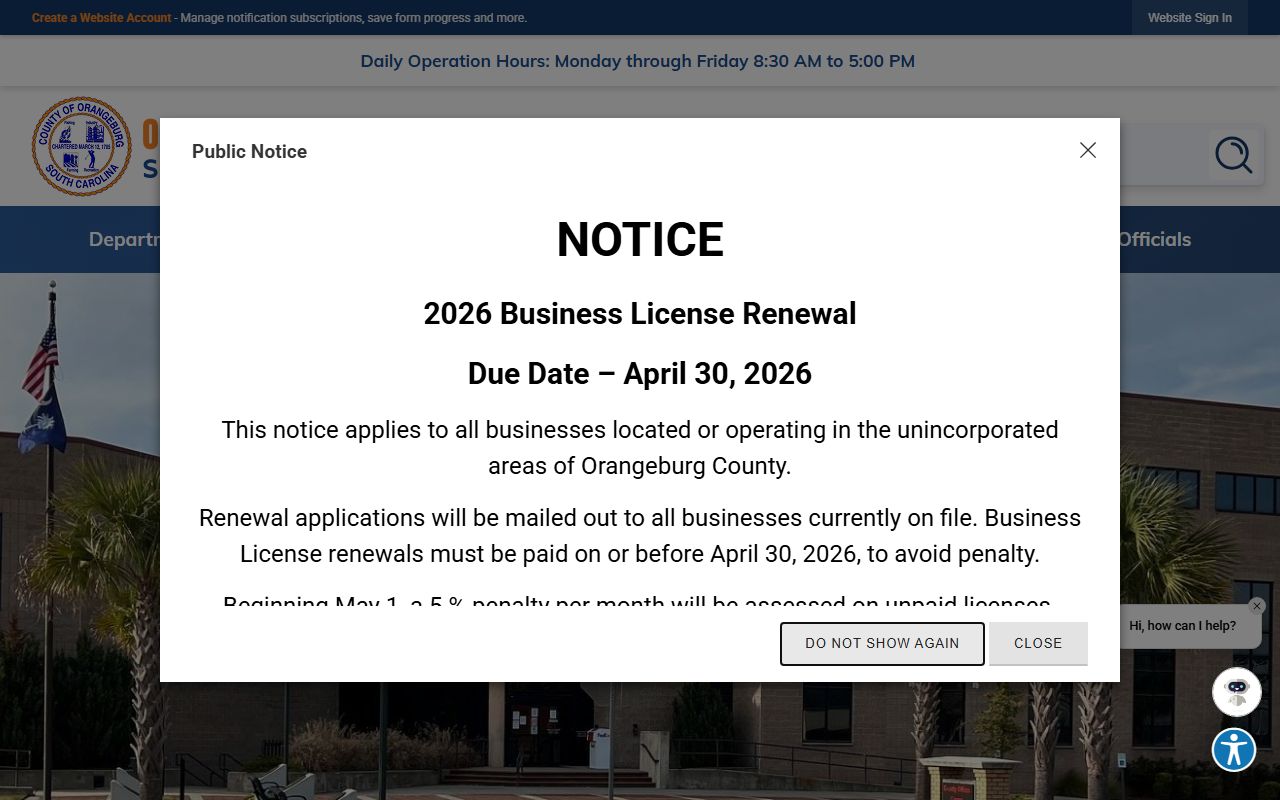
County offices in Orangeburg operate Monday through Friday and can assist residents with locally held tax accounts, refunds, and other county financial matters.
For broader information on all 46 South Carolina counties and their local government structures, the South Carolina Association of Counties maintains a reference site at sccounties.org. This resource covers county contact information, governing documents, and news from county governments across the state.
SC Dormancy Law and Annual Reporting for Orangeburg County
South Carolina's unclaimed property law is codified at SC Code Title 27, Chapter 18. This statute applies to all holders with accounts tied to Orangeburg County residents. The general dormancy period is five years for most financial accounts. Wages and utility deposits are reportable after one year. Money orders carry a seven-year period before transfer to the state is required.
By November 1 of each year, holders must report and transfer dormant property to the State Treasurer. Accounts with balances of $50 or more require written notice to the owner at least 120 days before that deadline. This due-diligence requirement is outlined in Section 27-18-180. If you receive one of these notices about a dormant account, respond quickly. Confirming your contact information and account activity prevents the funds from being transferred to the state.
The full dormancy table for all property types is at southcarolina.findyourunclaimedproperty.com/app/dormancy-table. Reviewing it against your older financial accounts helps you determine which ones may already be in the state system. County financial management is also subject to SC Code Title 4, Chapter 11.
The US Bankruptcy Court for South Carolina holds unclaimed funds from closed bankruptcy cases at scb.uscourts.gov/unclaimed-funds. Call 803-765-5436 for assistance. This is a separate database from the State Treasurer's system and should be searched independently if a bankruptcy proceeding involved an Orangeburg County address.
Note: Municipal governments in Orangeburg County that hold dormant funds are required to report them to the state. Guidance for local governments is available at masc.sc.
Cities and Communities in Orangeburg County
Orangeburg County includes the city of Orangeburg, as well as Holly Hill, Eutawville, Santee, Bowman, and numerous other communities. All residents across the county use the same statewide portal to search for unclaimed money.
No featured city pages are currently available for Orangeburg County. Use the state portal to search all communities.
Nearby Counties
Orangeburg County is bordered by Calhoun, Richland, Lexington, Aiken, Barnwell, Allendale, Colleton, Berkeley, Dorchester, and Clarendon counties. Residents who have lived in any of these surrounding counties should search the state portal under each address they have used, since unclaimed property records follow the last known owner address.