
Lexington County Unclaimed Money Search Guide
Lexington County has more than $35 million in unclaimed property accounts tied to its residents. This large sum reflects the county's fast-growing population and its mix of suburban neighborhoods, commercial corridors, and long-established communities. Dormant bank accounts, forgotten insurance proceeds, uncashed refund checks, and utility deposits make up the bulk of these funds. The good news is that South Carolina holds every dollar indefinitely, and searching is always free. Lexington County is also the home county of State Treasurer Curtis Loftis, who has made returning unclaimed property a signature priority of his office.
Lexington County Quick Facts
Lexington County Unclaimed Money and the State Treasurer
Lexington County holds a unique distinction: it is the home county of South Carolina State Treasurer Curtis Loftis, who has built his tenure around returning unclaimed property to its rightful owners. Under his leadership, the state has returned more than $420 million to South Carolina residents, with $36.7 million returned in a single recent year. Residents of Lexington County are well-served by this active program, and the $35 million or more identified in county resident accounts represents a real opportunity for families and individuals to recover lost funds.
The official search portal is at southcarolina.findyourunclaimedproperty.com. The image below comes from that portal.
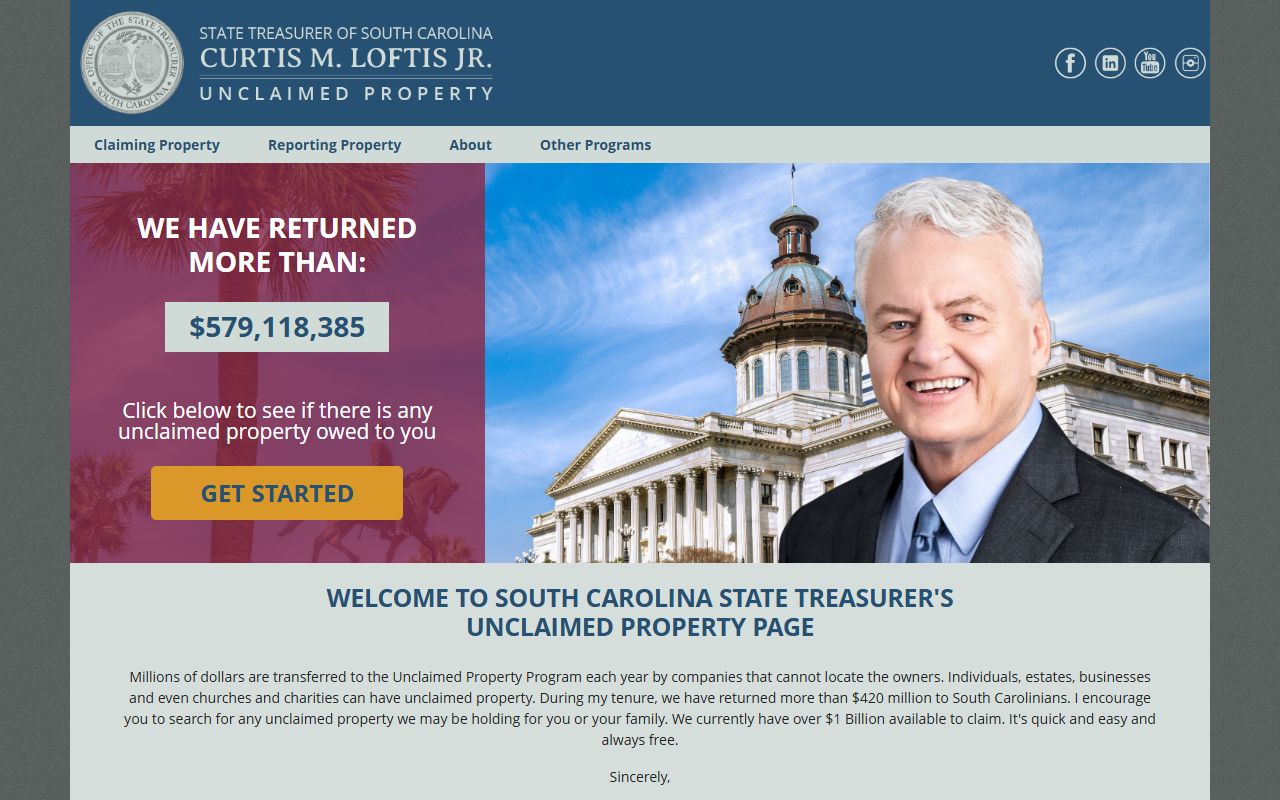
The portal is simple to use. Enter your name and review the results. You can search under a current name, a former name, a maiden name, or a business name to get the most complete picture of any property held in your name.
The full program page is at treasurer.sc.gov, and the office can be reached at 803-737-4771. Staff can guide you through the claim process from start to finish. Once you identify a match, you file a claim online, submit the required documentation, and wait for the state to process and return your funds. The process is straightforward for most claims.
Note: Searching under multiple name variations, including initials, nicknames, and maiden names, gives you the best chance of finding every account held in your name.
Lexington County Local Government and Tax Records
The Lexington County government website at lexcounty.com connects residents to all county departments. Property tax records, vehicle accounts, and other financial matters are managed through county offices in the town of Lexington, the county seat. Residents who have overpaid property taxes, received a vehicle credit, or have any other county-level financial matter pending should contact the appropriate county office through the main website.
County funds held on behalf of residents are governed by SC Code Title 4, Chapter 11. This law sets out how Lexington County must handle resident funds and when those amounts must be reported upward to the state. Tax refund checks that were mailed to outdated addresses and never cashed, escrow balance distributions from mortgage payoffs, and vehicle tax credits from cancelled registrations all fall under this framework. If you believe the county holds funds for you, a direct call to the relevant office is the most efficient first step.
Lexington County covers a large geographic area including Lexington, West Columbia, Cayce, Irmo, and Batesburg-Leesville. Each community generates its own mix of dormant accounts and unclaimed funds as residents move, change employers, or close old accounts. The county's population growth over the past decade has been among the highest in South Carolina, which also means a higher-than-average volume of property being reported to the state each year.
Types of Unclaimed Property in Lexington County
Bank accounts are the largest category of unclaimed property in Lexington County. Savings accounts, checking accounts, and CDs that show no owner activity for five years are transferred to the state. The West Columbia and Cayce areas along the Congaree River have long been commercial hubs, and residents in these communities have accounts at many regional and national banks. Bank mergers over the past two decades have also left behind dormant accounts from predecessor institutions that may appear in the state's database under old bank names.
Life insurance proceeds and annuity distributions are another major source. These funds build up when beneficiaries cannot be located after a policyholder passes away. The state requires insurers to check Social Security death databases and attempt to locate beneficiaries before reporting unclaimed proceeds. If you believe a family member's insurance policies were not fully paid out, searching under their name on the state portal is a quick way to check.
Lexington County's large rental market also generates a significant volume of utility deposits that go unclaimed. Residents who move without contacting their utility providers to close accounts, or who close accounts but never receive their deposits back, may find those funds in the state database. Utility deposits have a one-year dormancy period, so they reach the state faster than most other property types. The full dormancy schedule is at southcarolina.findyourunclaimedproperty.com/app/dormancy-table.
Note: Business owners in Lexington County should also search under their company names, since business accounts and vendor credits can end up as unclaimed property too.
SC Dormancy Rules for Lexington County Property
Understanding dormancy periods helps Lexington County residents know when to search and what to expect. South Carolina's rules are set out in SC Code Title 27, Chapter 18. The general dormancy period for most bank accounts and financial assets is five years. Wages and utility deposits become reportable after one year. Money orders reach the state after seven years, and travelers checks after fifteen years. Securities like stocks and mutual fund shares follow a three-year dormancy period.
The image below comes from the SC State Treasurer's dormancy table at southcarolina.findyourunclaimedproperty.com/app/dormancy-table.
The dormancy table is a practical reference that Lexington County residents can use to figure out whether a specific account has likely been reported to the state yet.
Section 27-18-180, available at Justia's SC code page, requires holders to send due diligence notices to owners at least 120 days before the November 1 reporting deadline. This notice gives you a final chance to reactivate your account with the original holder before the funds transfer to the state. Responding to these notices as soon as you receive them is always the best approach.
Lexington County Court Records and Federal Funds
Lexington County court records can be relevant to unclaimed money searches when civil judgments, estate distributions, or court-ordered payments were never received by the intended party. The county court system handles a wide range of matters, and unresolved financial issues from past cases can sometimes surface as unclaimed property years later. Reviewing court records is a useful step if you believe money from a legal matter was never delivered to you.
The US Bankruptcy Court for the District of South Carolina maintains a separate list of unclaimed funds from closed bankruptcy cases. These funds are not part of the state's unclaimed property program and require a separate search. Check that list at scb.uscourts.gov/unclaimed-funds or call 803-765-5436. Lexington County residents who have participated in federal bankruptcy proceedings as debtors or creditors should check both resources for a complete search.
Municipal governments in Lexington County, including those in Lexington, West Columbia, Cayce, and Irmo, also have unclaimed property obligations under state law. The Municipal Association of SC publishes guidance for local governments at masc.sc. If you believe a city or town government in Lexington County is holding funds for you, reach out to that municipality's finance office directly.
How to Claim Lexington County Unclaimed Funds
Claiming unclaimed money in Lexington County starts with a search at southcarolina.findyourunclaimedproperty.com. When you find a match, click through to begin the claim. The online form will ask for your personal information and will specify what documents you need to upload to prove ownership. For most claims, a government-issued photo ID and documentation showing your connection to the address on file is sufficient.
More complex claims, such as those involving a deceased person's estate, may require a death certificate, letters testamentary, or other probate documentation. The Treasurer's FAQ page at southcarolina.findyourunclaimedproperty.com/app/faq-info answers common questions about the process. You can also call 803-737-4771 with questions before or after you file.
There is no cost to search or claim. South Carolina returns the full value of the property with no reduction for fees. The state has made it a priority to actively reunite residents with their funds rather than simply holding them passively. Lexington County residents benefit directly from this commitment, given the $35 million or more identified for county residents in state records.
Note: Claiming funds for a deceased relative requires documentation, but the process is well-supported by the Treasurer's office staff, who can guide heirs through each step.
Cities in Lexington County SC
Lexington County includes a wide range of communities from the town of Lexington to the cities of West Columbia, Cayce, and Irmo. All residents use the same state portal to search for unclaimed property held by South Carolina.
Nearby Counties
Lexington County borders Richland, Saluda, Newberry, Aiken, Calhoun, and Orangeburg counties. Residents who have lived in neighboring areas may have unclaimed property tied to addresses in more than one county.